
Arnold J Toynbee (1889-1975) says, “India will conquer the conquerors” spiritually.
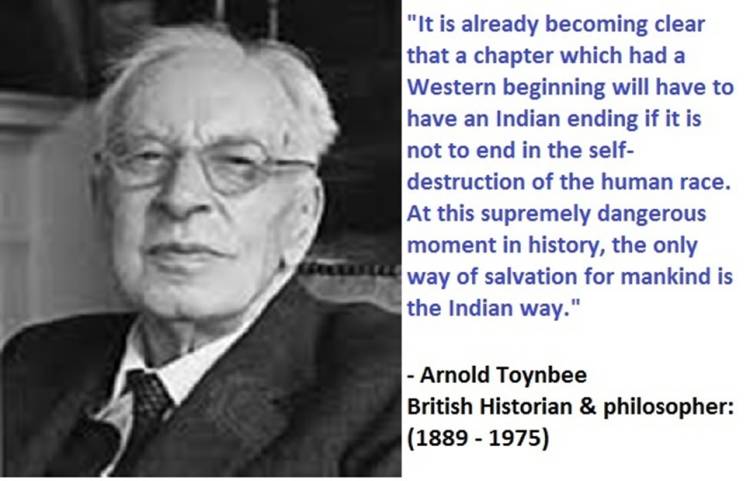 Arnold Joseph Toynbee (14 April 1889 – 22 October 1975) was an English historian, a philosopher of history, an author of numerous books, and a research professor of international history at the London School of Economics and King's College London. His massive research was published in 12 volumes between 1934 and 1961 as 'A Study of History'.
In the Study, Toynbee examined the rise and fall of 26 civilizations in human history and concluded that they rose by successfully responding to challenges under the leadership of creative minorities composed of elite leaders. Civilizations declined when their leaders stopped responding creatively, and the civilizations then sank owing to the sins of nationalism, militarism, and the tyranny of a despotic minority. Toynbee did not regard the death of a civilization as inevitable, for it may or may not continue to respond to successive challenges, shaped by spiritual, not economic forces.
Here you will see some of his ideas about nature, strength, and spiritual contribution of Hinduism.
"It is already becoming clear that a chapter which had a Western beginning will have to have an Indian ending if it is not to end in self-destruction of the human race. At this supremely dangerous moment in human history, the only way of salvation is the ancient Hindu way. Here we have the attitude and spirit that can make it possible for the human race to grow together into a single family."
“The tolerance of Hinduism was recognized by Toynbee, who on many occasions contrasted the exclusivity of the Jewish religion, based on the Jewish belief that the Jews are the chosen people with the large tolerance of the Hindus and Buddhist. This plague of exclusiveness, he claims, was inherited by both the Christians and Muslims: hence their lamentable record.” (Source: Concordant Discord - By R. C. Zaehner, p 22-23).
"So now we turn to India. This spiritual gift, that makes a man human, is still alive in Indian souls. Go on giving the world Indian examples of it. Nothing else can do so much to help mankind to save itself from destruction." (Toynbee’s Azad lecture in New Delhi in 1960).
"There may or may not be only one single absolute truth and only one single ultimate way of salvation. We do not know. But we do know that there are more approaches to truth than one, and more means of salvation than one.'' ''This is a hard saying for adherents of the higher religions of the Judaic family (Judaism, Christianity, and Islam), but it is a truism for Hindus. The spirit of mutual goodwill, esteem, and veritable love ... is the traditional spirit of the religions of the Indian family. This is one of India's gifts to the world." (Source: Britannia Perspectives - Quoted By T. V. R. Shenoy in Secularism is not for Hindus alone).
Toynbee predicted: "At the close of this century, the world would be dominated by the West, but that in the 21st century, India will conquer her conquerors." (Source: Spiritual Heritage of India - By Swami Prabhavananda Vedanta Press 1997).
"India is a whole world in herself; she is a society of the same magnitude as our Western society." (Source: Civilization on Trail and the World and the West - By Arnold Toynbee Meridian Books. p. 257).
In 1952, Toynbee had observed: "In fifty years, the world would be under the hegemony of the USA, but in the 21st century, as religion captures the place of technology, it is possible that India, the conquered, will conquer its conquerors." (Source: Power of the Indian mind: our heritage & asset - by Jagmohan - tribuneindia.com - editorial – Sunday February 23 2003).
"India is not only the heir of her own religious traditions; she is also the residuary legatee of the Ancient Mediterranean World's religious traditions."
"Religion cuts far deeper, and, at the religious level, India has not been a recipient; she has been a giver. About half the total number of the living higher religions are of Indian origin." (Source: One World and India - By Arnold Toynbee, Indian Council for Cultural Relations New Delhi. 1960, p 42-59).
Toynbee explains his position in clear terms: In our spiritual struggle, he says, "I guess that both the West and the world are getting to turn away from man-worshipping ideologies - Communism and secular individualism alike - and become converted to an Oriental religion coming neither from Russia nor from the West. I guess that this will be the Christian religion that came to the Greeks and the Romans from Palestine, with one or two elements in traditional Christianity discarded and replaced by a new element from India. I expect and hope that this avatar of Christianity will include the vision of God as being Love. But I also expect and hope that it will discard the other traditional Christian vision of God as being a jealous god, and that it will reject the self-glorification of this jealous god's "chosen people" as being unique. This is where India comes in, with her belief that there may be more than one illuminating and saving approach to the mystery of the universe." (Source: East and West: Some Reflections - By S. Radhakrishnan, p.128).
What Toynbee said about the Hindu philosophy of life and culture is very thought-provoking. He wrote: "We witness such unique mental approach and consciousness among Indians as may help humanity progress like a family unit. If we do not wish to perish in this atomic age, we have no other alternative left."
"Today, the western scientific progress has physically united the world. It has not only got rid of the 'space' factor, it has also equipped the various countries of the world with deadly arms. But they have not yet learnt the art of knowing and loving one another. If we want to save humanity at this most critical juncture, the only option is the Indian approach."
"India has a perception of life-force and has a vital role to play in the performance of human conduct, which will be beneficial not only to India but to the whole world in the present sorry state of affairs." (Source: Hindutva is universal love - By Girish Chandra Mishra - organiser.org).
“Hinduism has refrained from insisting on being given a privileged status, and in this act of self-denial it has, I should say, been strikingly true to its own spirit.” (Azad Memorial Lectures in Delhi in 1960)
“Today, the large-hearted, broad-minded religious spirit, India’s contribution to world unity that was once almost worldwide, survives in India almost alone. So, it looks as if it were now laid upon India to preserve this spiritual heritage as a common treasure for mankind—a treasure of inestimable value in the Atomic Age.” (Azad Memorial Lectures in Delhi in 1960)
Toynbee feels that devout Shaiva and devout Vishnu “would each recognize that the other was seeking truth and salvation in his own way, each might perhaps claim that his own way was the better one, at any rate for himself. But he would not maintain that his own way was the only way that had any truth or virtue in it. He would not contend that his neighbor's way was utterly false and vicious. He would not dismiss it as not being Hinduism, or as not being religion at all. Nor would he maintain that his own form of religion had been revealed, once for all, at some particular time and place.” (Azad Memorial Lectures in Delhi in 1960)
Sources: A study of History
Azad Memorial Lecture 1960 in New Delhi)
HinduWisdom.info


 Urgent support needed for Bangladesh Hindus


