
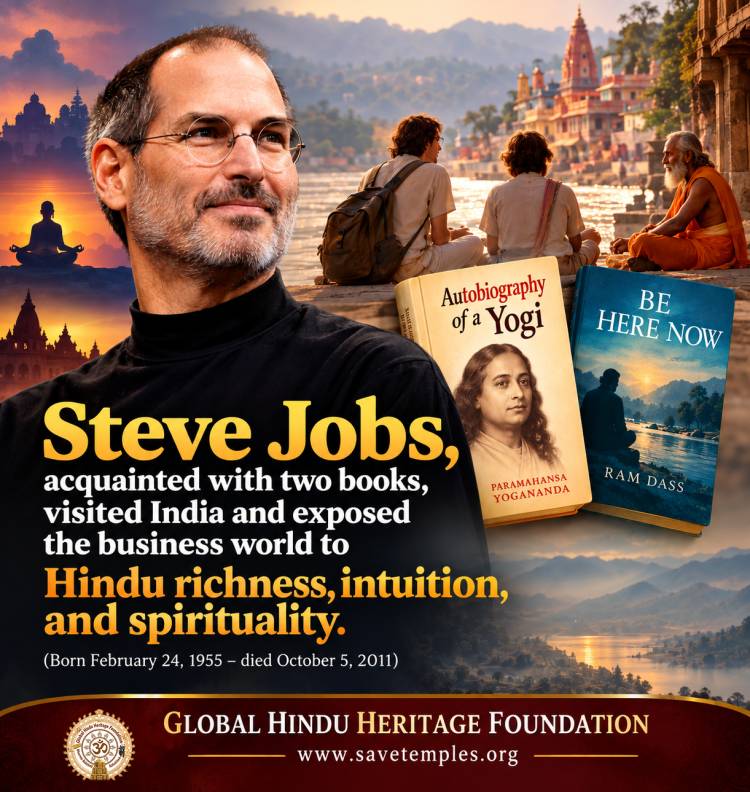
[GHHF] Steve Jobs, acquainted with two books, visited India and exposed the business world to Hindu richness, intuition, and spirituality.(Born February 24, 1955 – died October 5, 2011)
 GHHF - Oct 5 on “Islam, Democracy and Hindu Ideals: Is Bharat Ready to Protect Hindus?”
English: https://youtu.be/UQQfZofYxSg
Telugu: https://youtu.be/OocZHz7xIks
Hindi: https://youtu.be/xi5A6PPrZ70
Punjabi: https://youtu.be/Gex5Jtdj65k
Bengali: https://youtu.be/9uhdkn2uqWE
Paula and Clara Jobs adopted Steve Jobs. His father, a machinist and mechanic, influenced him. He used to work at a workbench, taking apart and rebuilding electronics, thereby developing an appreciation for craftsmanship, mechanical precision, and good design.
He enrolled in Reed College and dropped out. He said, “I didn't have a dorm room, so I slept on the floor in friends' rooms; I returned Coke bottles for the 5¢ deposits to buy food; and I walked the 7 miles across town every Sunday night to get one good meal a week at the Hare Krishna temple. I loved it.”
Two Books Influenced him
Steve Jobs came across Ram Dass’s “Be Here Now” during his first semester at Reed College in late 1972. After reading Harvard professor Ram Das’s “Be Here Now” and Paramahamsa Yogananda’s “Autobiography of a Yogi”, Steve Jobs traveled to India in 1974 with a friend, Dan Kottke, who later became Apple’s first employee. His trip to India was disappointing and revelatory at once, as he himself realized and recounted: “We weren’t going to find a place where we could go for a month to be enlightened.” Yet in a far more important sense, during his short fling into various Indian āshrams, Steve picked up the importance of cultivating inner centeredness and composure and looking at the world from the inside out. This orientation seemed to have served him well throughout his life as a leader of Apple.
Larry Brilliant, a lifelong friend of Steve Jobs, said, “He was searching for the same thing all of us search for, what we’re still searching for, the meaning of life, why we live, how we can do anything good in our lifetimes.” He was also searching for raw food, as Brilliant puts it — “Where the hell am I going to get a good salad?”
“Be Here Now” was the book about Neem Karoli Baba. Then Robert Friedland told us about the Kumbh Mela in Hardwar/Rishikesh in the summer of 1974, which became the springboard for deciding to go. Steve Jobs and his friend Kottke went to India, wore khaki kurtas and lungis, trying to blend in. Then they went to Kainchi near Neem Karoli’s ashram. They tried smoking hemp. But as they say, “But really it was the books that had the most interest for us. I remember carrying around the Hundred Thousand Songs of Milarepa, The Book and The Way of Zen by Alan Watts, the Diamond Sutra, and the Dharma Bums by (Jack) Kerouac.”
How did the trip to India influence them? Kottke said, “I think the trip influenced us both in a general sense of broadening our experience of life on earth and putting our lives in the US in a wider perspective.” Both were sick, suffering from diarrhea and fatigue. But those seven months influenced those seeking spiritual enlightenment, deepening their lifelong interest in Eastern philosophy and minimalism.
His biographer, Walter Isaacson, wrote that the greatest influence on Steve Jobs, however, was the book Autobiography of a Yogi— “the guide to meditation and spirituality that he had first read as a teenager,” “then re-read in India and had read once a year ever since.” Isaacson mentions it was the only book Steve downloaded on his personal iPad2. Steve’s credo, “Actualize yourself,” seems to come directly from Yogananda’s philosophy of Self-realization. (realize, portray, objectify yourself).
Jobs found himself deeply influenced by a variety of books on spirituality and enlightenment, most notably “Be Here Now,” a guide to meditation and the wonders of psychedelic drugs by Baba Ram Dass, born Richard Alpert.
“It was profound,” Jobs said. “It transformed me and many of my friends.”
Steve Jobs learned important lessons from the book: the importance of holy curiosity and a sense of wonder, self-effort, self-realization, and, above all, fearlessness in facing life and death. Jobs, who in his 2005 Stanford Commencement Speech memorably described death as “very likely the single best invention of life,” departed from this world exclaiming: “Oh wow. Oh wow. Oh wow.” In the same speech, signaling the importance of loving what we do, he noted, “Your work is going to fill a large part of your life, and the only way to be truly satisfied is to do what you believe is great work. And the only way to do great work is to love what you do.”
To conclude, we would highlight a few points from his lifestyle: he was a vegetarian, practiced yoga routinely, and was known for his strong love and compassion for animals. These seem so connected to Hinduism, don’t they?
Intuition
Marc Benioff, Salesforce CEO, said Steve Jobs’s keys to success were the spiritual qualities he developed. “He went to India,” said Benioff, “And he had this incredible realization that his intuition was his greatest gift, and that he needed to look at the world from the inside out.”
"I look at Steve as a very spiritual person," he added. "[Steve] had this incredible realization--that his intuition was his greatest gift and he needed to look at the world from the inside out."
He deeply valued and trusted intuition. He used to say, don’t let the noise of others’ opinions drown out your own inner voice. And most importantly, have the courage to follow your heart and intuition. They somehow already know what you truly want to become. Everything else is secondary.”
Benioff even stated that, "If you look back at the history of Steve and that early trip to India...he had this incredible realization that his intuition was his greatest gift." "He needed to look at the world from the inside out...his message was to look inside yourself and realize yourself." "Yogananda...had this book on self-realization.... [Steve's] last message to us was that here is Yogananda's book.... Actualize yourself.
Stanford University Speech
Steve Jobs delivered a motivating speech at Stanford University about simple living and high thinking, which became a sensation. While addressing Stanford University graduates, he shared three life-changing stories that really moved them. The first story was about connecting the dots, the second about love and loss, and the third about his belief in Karma.
“Again, you can’t connect the dots looking forward; you can only connect them looking backward. So you have to trust that the dots will somehow connect in your future. You have to trust everything: your gut, destiny, life, karma, whatever. This approach has never let me down, and it has made all the difference in life”.
Last gift – Autobiography of a Yogi
When he came to know that he had cancer and might not live long, he carefully planned his funeral, prepared the list of guests to be invited to the funeral, and the kind of gift he wanted to give. Hundreds of influential leaders in business, politics, and popular culture were introduced to Paramahamsa Yogananda’s Autobiography of a Yogi at the 2011 memorial service for Steve Jobs, at the express wish of the late business visionary and founder of Apple Computer, who passed away on October 5, 2011.
Benioff told his story of attending the memorial service following Jobs’ death, where the attendees were handed a small brown box on their way out. ‘This is going to be good,’ he thought. ‘I knew that this was a decision he made, and whatever it was, it was the last thing he wanted us all to think about.’
“The box contained a copy of Paramahamsa Yogananda’s book, Autobiography of a Yogi. It was a spiritual book that inspired Jobs throughout his life. First published in 1946, the book espouses ‘self-realization’ and the practice of Kriya Yoga meditation.
“We need to all be working on actualizing ourselves,” Benioff added. “If you want to understand Steve, it’s a good idea to dig into it [Autobiography of a Yogi]. He was not afraid to take that key journey.”
Your donations are appreciated;
By Zelle: ghhfusaorg@gmail.com
PayPal: savetemples.org
By Check: GHHF, 14726 Harmony Lane, Frisco, TX 75035.
By Rupees: call 601-918-7111; +91 83096 43979


 Urgent support needed for Bangladesh Hindus


