
[GHHF] Carl Sagan, a Scientist who appreciated Hinduism's contribution to the world: time scales, Hindu cosmology, and dancing Lord Shiva.
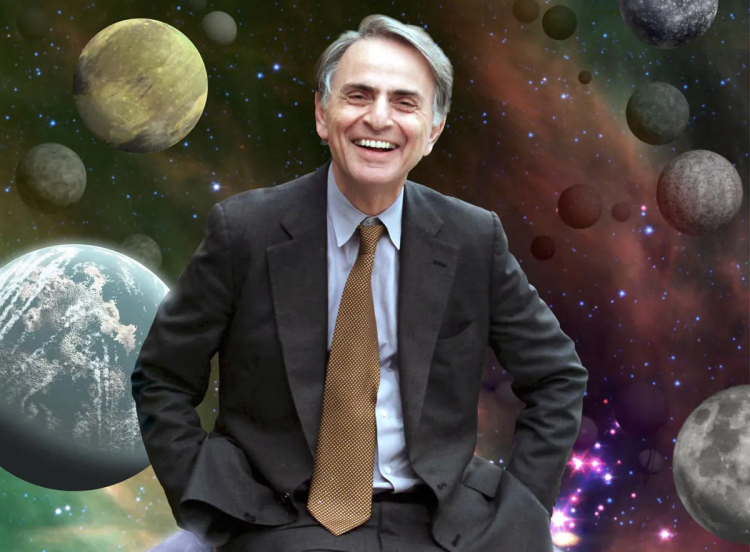 Carl Sagan was born on November 9, 1934, and died on December 20, 1996. Carl Sagan was an astronomer, scientist, celebrity, writer, professor, skeptic, and free thinker; he was much more than the narrator of a TV series. Carl Sagan expressed a profound appreciation for Hinduism, particularly its cosmological insights, which he regarded as advanced and relevant to modern scientific discussions. He highlighted the unique perspective of cyclical time in Hindu cosmology, noting its alignment with contemporary understandings of the universe.
This legend in his own lifetime was a first-rate philosopher, poet, scientist, and a splendid example of human greatness all rolled into one.
The Hindu religion is the only one of the world’s great faiths dedicated to the idea that the Cosmos itself undergoes an immense, indeed an infinite, number of deaths and rebirths.
It is the only religion whose time scales match those of modern scientific cosmology. Its cycles run from our ordinary day and night to a day and night of Brahma, lasting 8.64 billion years. Longer than the age of the Earth or the Sun and about half the time since the Big Bang.”
"In his landmark TV series Cosmos, Carl Sagan called Hinduism the only religion whose time-scale for the universe matches the billions of years documented by modern science. Sagan filmed that segment in a Hindu temple featuring a statue of the god Shiva as the cosmic dancer. This image now stands in the plaza of the European Organization for Nuclear Research in Geneva."
"It is the clearest image of the activity of God which any art or religion can boast of." Modern physics has shown that the rhythm of creation and destruction is not only manifest in the turn of the seasons and in the birth and death of all living creatures, but also the very essence of inorganic matter".
At the very onset, Carl cited the ancient Hindu sacred text of the Rigveda and conceded, “The most sophisticated cosmological ideas came from Asia and particularly from India. Here, there is a tradition of skeptical questioning and unselfconscious humility before the great cosmic mysteries.”
Most cultures imagine the world to be a few hundred human generations old. Hardly anyone guessed that the cosmos might be far older, but the ancient Hindus did,” Carl stated. He then spoke about the harvest festival of Pongal, celebrated in South India, especially in Tamil Nadu. Carl emphasized that the Hindu festival had ties to an ‘elegant and much deeper cosmological tradition’ and that it rejoiced in the cycles of nature.
For modern physicists, then, Shiva's dance is the dance of subatomic matter. Hundreds of years ago, Indian artists created a beautiful series of bronzes depicting dancing Shivas. Today, physicists have used the most advanced technology to portray the pattern of the cosmic dance. Thus, the metaphor of the cosmic dance unifies ancient religious art and modern physics. The Hindus, according to Monier-Williams, were Spinozists more than 2,000 years before the advent of Spinoza, and Darwinians many centuries before Darwin, and Evolutionists many centuries before the doctrine of Evolution was accepted by scientists of the present age.
His (Sagan's) true genius lay in the many esoteric philosophical and scientific endeavors which only specialists can really appreciate. But he became an instant pop science icon when he co-authored "COSMOS", a television series devoted to astronomy and space exploration.
Carl Sagan observed that the main reason we oriented this episode of "COSMOS" toward India is the remarkable aspect of Hindu cosmology, which, first of all, gives a timescale for the Earth and the universe a timescale consonant with modern scientific cosmology. We know that the Earth is about 4.6 billion years old, and the cosmos, or at least its present incarnation, is something like 10 or 20 billion years old. The Hindu tradition has a day and night of Brahma in this range, around 8.4 billion years.
There is the deep and appealing notion that the universe is but the dream of the god who, after a 100 Brahma years dissolves himself into a dreamless sleep and the universe dissolves with him until after another Brahma century he starts recomposes himself and begins the dream again the great cosmic lotus dream.
Sagan highlighted that Hinduism contains some of the earliest descriptions of cosmic time scales that closely match modern astrophysics. He noted that Hindu cosmology describes a universe billions of years old, with repeating cycles of creation and dissolution ideas remarkably similar to scientific theories.
In his landmark documentary series 'Cosmos', Sagan introduced millions of viewers to Hindu concepts such as the cosmic dance of Shiva, the vast cycles of yugas, and the expansive vision of time found in the Vedas and Puranas. His respectful presentation helped show Hindu cosmology as intellectually rich rather than mythological.
Carl Sagan, while describing the bronze Shiva dance image, described it as the most elegant and sublime of these bronzes, representing the creation of the Universe at the beginning of each cosmic cycle a motif known as the cosmic dance of Shiva. “The God has four hands. In the upper right hand is the drum whose sound is the sound of creation. And in the upper left hand is a tongue of flame a reminder that the universe now newly created will billion of years from now will be utterly destroyed. Creation. Destruction.”
Sagan observed that Hinduism’s cyclical model of the universe aligns with scientific ideas like oscillating universes, cosmic expansion and contraction, and the possibility of multiple creations. He praised the ancient rishis for envisioning time scales far ahead of those of other civilizations.
Through his work, Sagan encouraged dialogue between science and ancient wisdom traditions. By referencing Hindu ideas in his scientific discussions, he opened the door to acknowledging that spiritual texts may contain profound insights into the nature of reality.
In conclusion, Carl Sagan’s greatest contribution to Hinduism was elevating its cosmology onto the world stage demonstrating its advanced philosophical and scientific understanding of the universe, and showing how ancient Hindu insights remain relevant in modern scientific discussions.
Your donations are appreciated.
By Zelle: ghhfusaorg@gmail.com
PayPal: savetemples.org
By Check: GHHF, 14726 Harmony Lane, Frisco, TX 75035.
Call 601-918-7111; +91 83096 43979


 Urgent support needed for Bangladesh Hindus


