
[GHHF] Celebration of Devi Navaratri – Students learned about the Mother Goddess's indomitable power and how she eliminated evil forces.
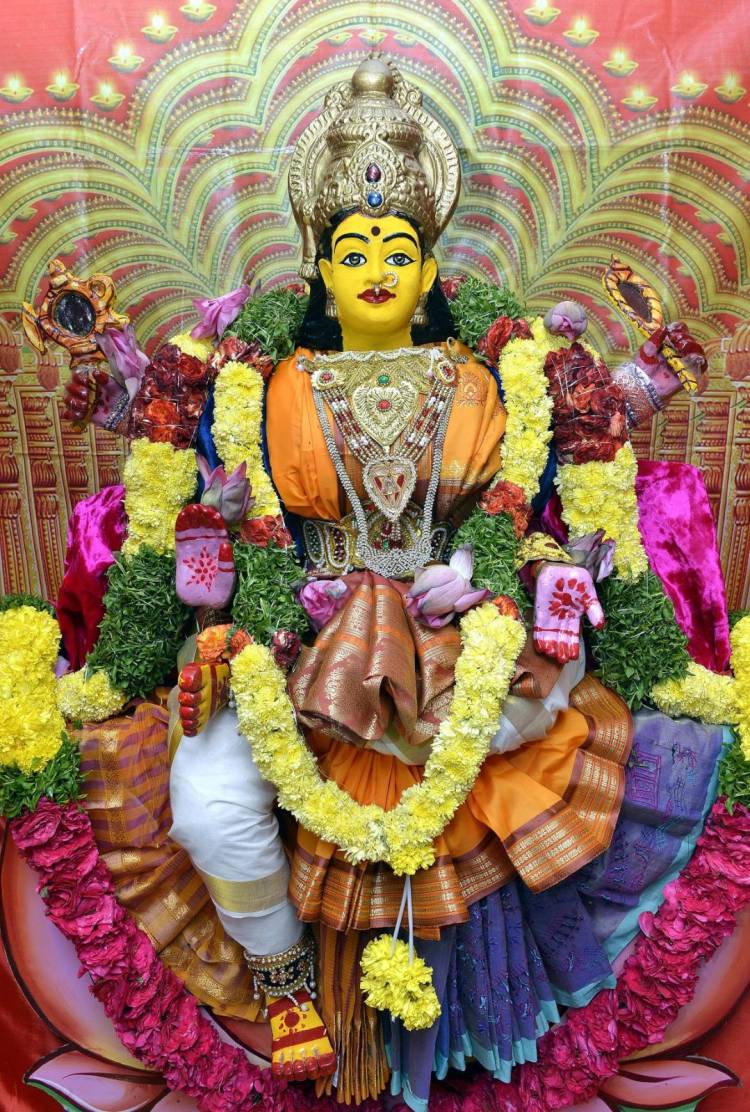 Part 1 The End of Ego — Mahishasuramardini
Mahishasura was a powerful Asura and a shapeshifter who could assume the form of a Mahisha (buffalo). His excessive pride in his immense power fueled his greedy ambition to rule the three worlds. Driven by this desire, he performed severe penance to please Lord Brahma.
Pleased with his penance, Lord Brahma appeared before him and asked him to choose a boon. When Mahishasura sought immortality, Brahma clarified that death is inevitable for every living being. Mahishasura then reflected and asked that no male being—god, demon, or human—nor any animal cause his death.
His arrogance, which viewed women as weak beings, fostered a blind belief that no woman could ever conquer him. Lord Brahma granted this boon.
Empowered by this boon, his arrogance knew no bounds; he invaded the heavens, drove out Indra, and enslaved the gods. The helpless gods sought refuge with the Trimurti. Realizing that no single deity could confront Mahishasura, the Trimurti united the divine energies of all the gods. From the confluence of these magnificent energies, Goddess Durga—the embodiment of supreme power and the Universal Mother—manifested.
With Shiva offering His trident, Vishnu His Sudarshana Chakra, Indra His Vajrayudha, and Himavan a lion as her mount, the Universal Mother—now riding the lion and armed with the weapons of all the gods—marched to the battlefield.
A Nine-Day Struggle for Righteousness — The Origin of Navaratri
The Divine Mother's battle against Mahishasura did not end in a single moment. According to the Devi Bhagavata and Markandeya Purana, the Universal Mother fought a fierce, ceaseless battle against the demon hordes for nine days and nine nights.
Although Mahishasura attempted to deceive Her by shapeshifting into a buffalo, a lion, a human, and an elephant, the Goddess countered him using nine distinct powers. Finally, on the tenth day (Dashami), She slew him in his buffalo form with Her trident, thereby liberating the worlds.
Navratri commemorates those nine nights of divine struggle; Vijayadashami marks the Dharma victory achieved on the tenth day.
Mahishasura fell not because he lacked power, but because he prided himself on seeing women as weak. Our Indian culture has never seen women as weak; Sakshat respects creation, status, and rhythm as the primordial power. “Yatra Naryastu Pujyante Ramante Tatra Devtah” Where women are respected, there is a measure of divinity.
Nine Nights of Spiritual Practice — Navaratri
The tradition of Navaratri—worshipping the Divine Mother for nine nights and commemorating her great victory over Mahishasura—holds a special place in Indian spiritual life. Navaratri is not merely a nine-day festival; it is a period of spiritual practice (sadhana) dedicated to worshipping the Goddess while disciplining our bodies, minds, thoughts, and habits. According to our tradition, we observe the Navaratri vow from the first day (Prathama) to the ninth day (Navami) of the bright fortnight of the Ashwayuja month, culminating in Vijayadashami on the tenth day. The Devi Bhagavatam identifies the autumn (Sharad) and spring (Vasanta) seasons as ideal times for this special Navaratri worship, while also highlighting the unique significance of the Navaratri rituals performed during autumn.
The transition from monsoon to autumn marks a shift in nature. Various factors—such as weather, temperature, humidity, and the length of day and nightshift. Since our bodies are an integral part of nature, they adjust their metabolic processes in harmony with these changes. Ayurveda views this period as a crucial time to maintain the balance of the body's doshas. It specifically highlights the aggravation of Pitta during autumn and emphasizes practices such as dietary guidelines, lifestyle adjustments, and body cleansing.
This is why people observe practices like fasting, eating limited and Sattvic (pure and wholesome) food, and leading a disciplined lifestyle during Navaratri. Reducing food intake is not merely about staying hungry; it is about proving to ourselves that we have control over our diet.
Modern biology also explains that fasting influences the body's metabolic processes. When nutrients are unavailable, cells actively engage in a natural process known as autophagy, wherein they break down and recycle their own old or damaged components. Yoshinori Ohsumi was awarded the Nobel Prize in 2016 for his research on this cellular process. Thus, fasting in our tradition is not merely a spiritual observance; it is a lifestyle practice that impacts the body's metabolism.
Nighttime worship holds a special significance during Navaratri. During the day, our senses are constantly engaged with the external world, whereas the outside world grows quieter after nightfall. We use this silence for practices such as Japa (chanting), meditation, scriptural recitation, and lighting lamps, which are integral to our tradition. Our bodies also have a unique biological clock governed by the night; as darkness sets in, the pineal gland releases a hormone called melatonin. This hormone plays a crucial role in regulating our sleep-wake cycle—or circadian rhythm. As a result, dedicating the night to tranquil spiritual practice aligns naturally with our body's biological clock.
Recitation of the Lalita Sahasranama and Durga Saptashati: Continuous mantra chanting during Navaratri generates specific frequencies. Pronouncing Sanskrit Beejaksharas (seed syllables) stimulates alpha and theta brain waves. This process reduces cortisol (the stress hormone) levels while enhancing mental peace, memory, and concentration. Sounds such as Harati (ritual lamp waving), temple bells, and conch blasts also help curb the spread of harmful microorganisms in the surroundings. This offers an interesting modern scientific perspective on the importance our ancestors placed on Japa (repetition of mantras), meditation, and Mantra Sadhana (mantra practice) thousands of years ago.
Viewed in this light, the dietary discipline observed during Navaratri regulates the body; Japa (repetition of mantras) and meditation discipline the mind; worship elevates our thoughts; and adherence to discipline strengthens our resolve. Thus, Navaratri is not merely a nine-day period of worshipping the Goddess externally, it is also a nine-day spiritual practice to awaken the divine energy within us. The forms of Nava Durga worshipped over these nine nights are not limited to rituals; they also serve as divine guideposts for human evolution.
Your donations are appreciated.
By Zelle: ghhfusaorg@gmail.com
PayPal: savetemples.org
By Check: GHHF, 14726 Harmony Lane, Frisco, TX 75035.
By Rupees: call 601-918-7111; +91 83096 43979


 Urgent support needed for Bangladesh Hindus


