
[GHHF] Why do Hindus observe Pitru Paksha? What are its significance and benefits?
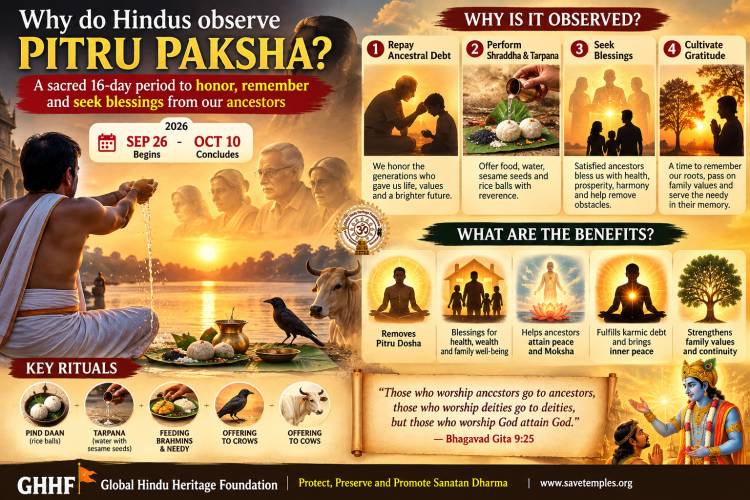 Hindus observe Pitru Paksha (a sacred 16-day lunar period during the waning phase of the moon) primarily to honor, remember, and thank their ancestors. Pitru Paksha means “fortnight of the ancestors,” during which the living connect with their ancestors by performing Shradha, which includes cooked food, water, sesame seeds, and rice balls. In 2026, Pitru Paksha begins on September 26 and culminates on October 10.
Why do Hindus observe Pitru Paksha?
1) Repaying Ancestral Debt (Pitru Runa): Hindu philosophy teaches that every individual is born with certain debts. Pitru Runa is the debt owed to one's parents, grandparents, and earlier generations who nurtured, protected, and preserved the lineage, culture, and values that make modern existence possible.
2) Performing Shraddha and Tarpana: During this fortnight, families perform specific rituals such as Shraddha (offerings made with utmost reverence), Pind Daan (offering rice and sesame balls), and Tarpana (offering water mixed with sesame seeds). These rites are performed on the specific lunar day (tithi) corresponding to an ancestor's passing to help liberate their souls and grant them peace in the afterlife (Pitru Loka).
3) Seeking Blessings: It is believed that satisfied ancestors bestow health, harmony, wisdom, and prosperity upon their living descendants, while also helping clear lingering karmic obstacles (Pitru Dosha) in the family tree.
4) Cultivating Gratitude and Continuity: Beyond strict rituals, Pitru Paksha serves as a designated time to reflect on family roots, remember the sacrifices of past generations, and pass down cultural memory to younger family members. Acts of charity—such as feeding the needy, priests, cows, and crows—are also performed in the name of the departed as a gesture of universal compassion.
Hindu scriptures such as the Garuda Purana, Brahma Purana, Agni Purana, and epics like the Mahabharata detail the profound metaphysical, karmic, and moral importance of Pitru Paksha. Across these scriptures, the observance is framed not merely as a cultural custom, but as a core pillar of Sanatana Dharma (eternal duty).
In the Bhagavad Geeta (Chapter 9, Verse 25), Lord Krishna explains: “Those who worship ancestors go to ancestors, those who worship deities go to deities, but those who worship God attain God.” This shows that while worshiping ancestors is a noble duty, the highest goal of life is devotion to the Supreme. Still, by performing Shraddh rituals, we fulfill our responsibility towards the souls who gave us life and blessings. Further, the Bhagavad Gita says, "The soul is neither born, nor does it ever die; nor having once existed, does it ever cease to be. The soul is without birth, eternal, immortal, and ageless. It is not destroyed when the body is destroyed." (2:20). The body may perish, but the soul journeys onward.
Thus, scriptures explicitly stress that Pitru Paksha is incomplete without Daan (charity). Texts state that feeding the hungry, distributing food to Brahmins, and offering morsels to animals and birds (particularly crows and cows, viewed as messengers or bridges to the ancestral realm) fulfills the law of cosmic reciprocity. Doing good deeds and feeding others in the name of the departed generates merit (punya) that directly benefits both the living lineage and the ancestors' souls.
According to the Mahabharata, after Karna was killed, they took him to heaven, where they offered him jewels and gold as food when he was hungry. Indra told him that he had never offered food to the ancestors, only jewels and flowers. Realizing his grave mistake, Karna asks Indra for 15 days to make it right. During this time, he returned to Earth, performed shraddha for his ancestors, and offered food in their memory. Because Karna stayed on Earth during these days, Hindus celebrate this period as Pitru Paksha, and it has become a tradition to offer Pinda Shraddha to departed souls.
What are the benefits of doing Pitru Paksha?
Observing Pitru Paksha brings several spiritual, psychological, and familial benefits according to Hindu tradition and cultural ethos:
• Properly performing ancestral rites is believed to appease unsatisfied ancestral souls, thereby mitigating or resolving Pitru Dosha—an astrological affliction thought to cause ongoing hurdles, health struggles, or marital and career delays in a family.
• By expressing gratitude to our ancestors, they reciprocate with blessings for health, wealth, longevity, peace, and overall family well-being.
• Performing rituals like Shraddha and Pind Daan, they are believed to nourish the souls of the deceased, helping them attain Moksha (liberation from the cycle of rebirth)
• Fulfilling duties toward one's ancestors, they free an individual from karmic debt (Pitru Rina), bringing a sense of inner peace and spiritual alignment.
• Performance of these rituals reveals our deep sense of identity, respect for elders, and continuity of family values.
Your donations are appreciated;
By Zelle: ghhfusaorg@gmail.com
PayPal: savetemples.org
By Check: GHHF, 14726 Harmony Lane, Frisco, TX 75035.
By Rupees: call 601-918-7111; +91 83096 43979





 Urgent support needed for Bangladesh Hindus


